AI in tourism: what really works for incoming tour operators
AI in tourism, seen from incoming: three uses that already help a tour operator, three promises to treat with caution, and where it makes sense to start.
Contents
There is a lot of talk about AI in tourism, and incoming tourism is no exception. Some uses are already making a tour operator’s daily work simpler. Others are promises bigger than what they bring to operations today.
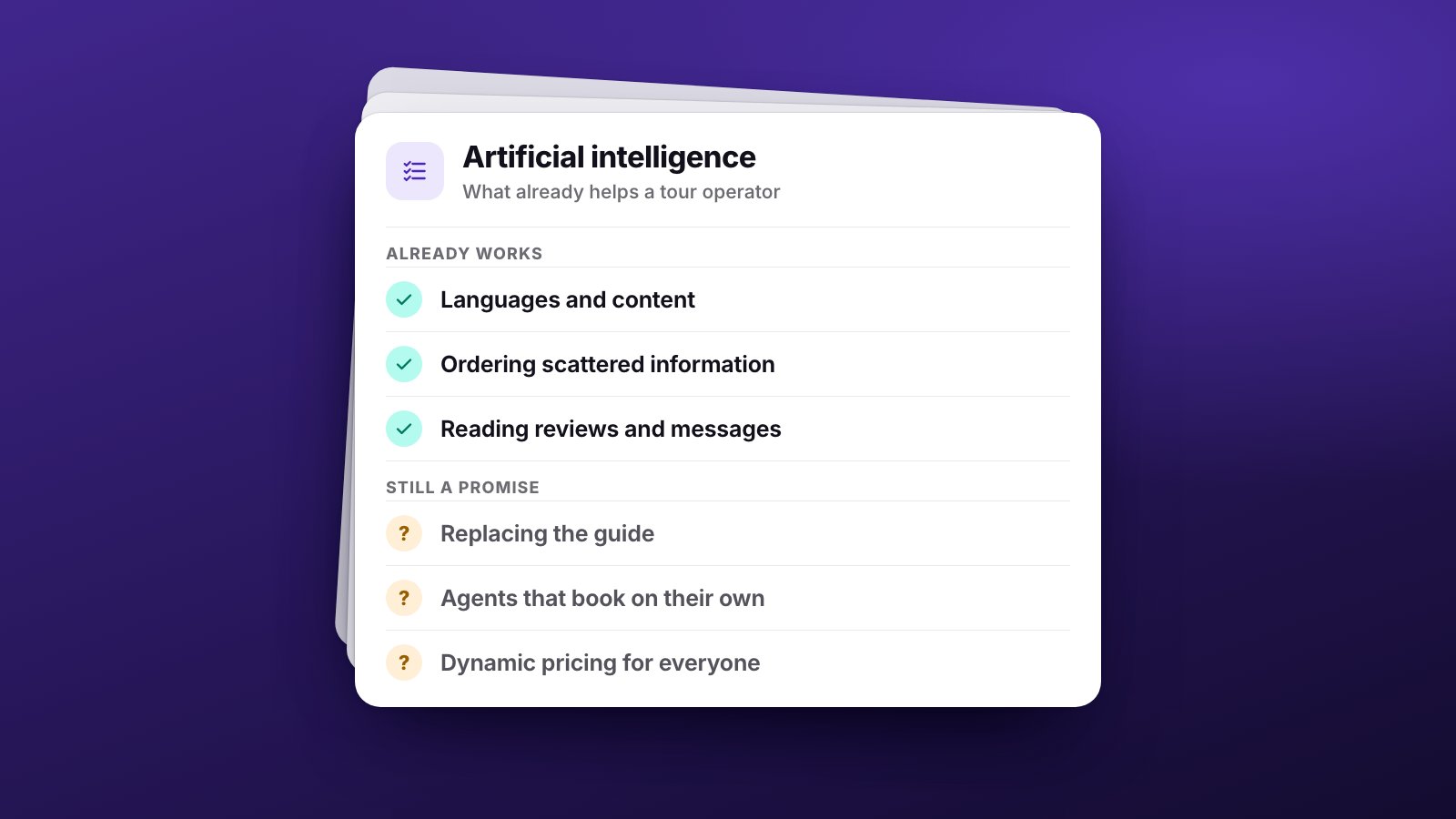
Here we gather three uses that we think already work and three promises still worth treating with caution. It is our team’s opinion, not a study: no percentages, just everyday work.
AI in tourism: what already works
1. Languages and content
AI can help write replies to enquiries before the booking, adapt a tour’s listing to different sales channels and translate materials for customers and guides.
It is a quick, accessible and low-risk use, on one condition: that a person reads the text before it is published or sent.
2. Putting scattered information in order
Bookings arrive from OTAs, from the company’s website and from other channels, and not always in the same format. AI can help standardise names, find duplicates, extract data from PDF vouchers and reconcile invoice information.
It is not the most spectacular use, but it is among those that can genuinely give working hours back to the team.
3. Reading reviews and messages in bulk
Many reviews and messages can be grouped by tour, guide, language, time slot or type of problem. AI doesn’t make the decision for you, but it helps you see what keeps coming up and where to look.
What is still more promise than reality
1. “AI will replace the guide”
An audio guide or a digital assistant can enrich the experience, but they don’t replace an experienced guide who reads the group, adapts the story, answers questions and handles the unexpected. Technology can support the service; the human side remains an essential part of the product.
2. “AI agents will book on their own and replace the OTAs”
The conversation is only one part of the process. Before and after a booking there is still real availability, places to manage, payments, changes, cancellations and customer service. And someone has to respond when a passenger doesn’t turn up at the meeting point or a supplier changes the time. What OTAs bring a tour operator today is covered in What is an OTA in tourism.
AI can make buying easier, but it doesn’t remove the operational work.
3. “AI-driven dynamic pricing for any operator”
Without enough historical data, clear rules and an accurate knowledge of costs and margins, there is little to optimise. For many tour operators the first step is not a predictive model: it is knowing what each service really costs to run.
The limit: it doesn’t fix a process that isn’t there
AI gives good results when it reads, translates and puts information in order. It shows its limits when it has to replace professional judgement and operational management.
And it doesn’t fix a process that doesn’t exist. If the day’s services live across spreadsheets, emails and WhatsApp, the only effect is to speed up the mess.
Where to start: operations data in one place
Any automation, with or without AI, only works well on tidy data: which tours run, with how many people, with which guide and at what cost. TourOperate, connected to Bókun, keeps exactly this data in order:
- Bookings already in place. Products, rates and bookings come from Bókun. Every booking links itself to its departure, meaning the tour on that day at that time, with nothing to copy.
- Who is working, and whether anything is missing. You assign guides, drivers, escorts and vehicles to each departure. TourOperate marks it Ready when nothing is missing, otherwise Not ready, and works this out from the data.
- Each day’s passengers. The passenger details page gathers the bookings and passengers of a day, with the details the service needs, and you export it all to Excel.
- The cost of every service. Cost rules tell you what you pay a guide, a driver or a vehicle on each departure. Each departure shows what was sold, the costs and the profit, and the cost report sums up what your resources cost over a period and the cost per passenger.
This is the information you need to answer questions like the one about pricing: before you have anyone calculate prices, you need to know what each tour really costs. The work after the sale is described task by task in our guide to tour operator software; for the full flow, read How it works.
Organise your days with TourOperate
Try it free