Inbound tour operator: what it does and how it runs the work on site
What an inbound tour operator does, how it differs from an outbound one, which services it runs at the destination and the work behind every booking.
Contents
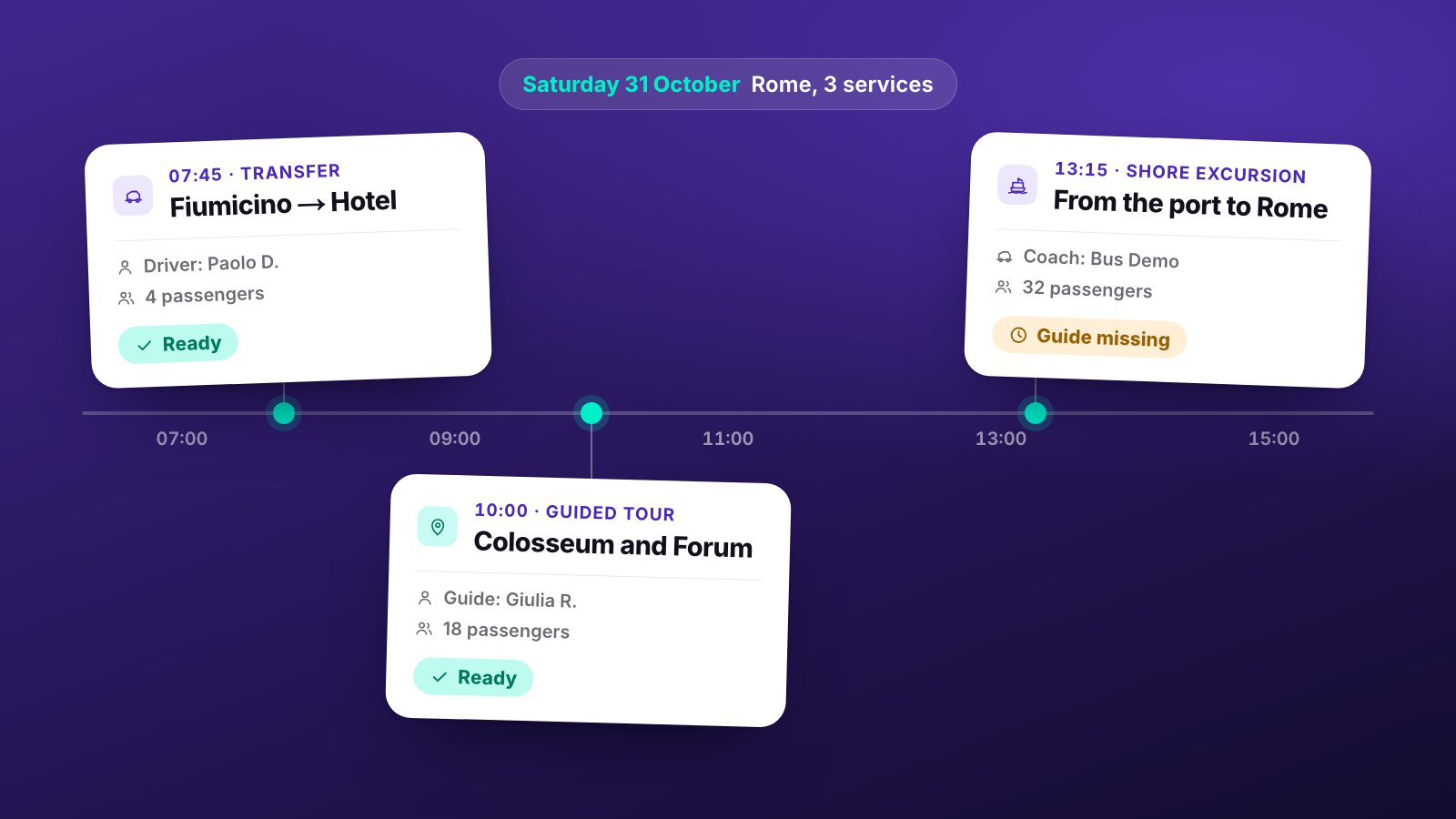
A group steps off a cruise ship and finds its coach waiting at the port. A couple lands at Fiumicino and a driver is there with a name sign. A family meets their guide outside the Colosseum. Behind these scenes there is often an inbound tour operator, also called an incoming tour operator: the company that welcomes travellers at the destination and organises what they do there.
Here is what it does, how it differs from an outbound operator, where it sells and what work is left after every booking.
What an inbound tour operator is
An inbound tour operator, also known as a receptive operator, works at the destination and for the people who arrive there. It knows the area, has contacts with guides, drivers, restaurants, museums and local suppliers, and turns all of this into services a traveller can book.
Its customers can be individual travellers, groups, travel agencies and tour operators from other countries, cruise lines and companies. What it sells is an experience on the ground: a visit, a transfer, a day out of town.
Inbound and outbound tour operators: the difference
The difference is the direction of travel.
- An outbound operator works in the country travellers leave from and sends them abroad: it puts the trip together, often with flights and hotels, and sells it to the people who are leaving.
- An inbound operator works in the country of arrival and receives the travellers: it organises and runs the services at the destination.
The two often work together: a German outbound operator selling a week in Italy can hand the transfers, tours and excursions to an Italian inbound operator.
The services of an inbound tour operator
Every company has its own catalogue, but some services come up in almost all of them:
- Guided tours of museums, monuments and historic centres, with a guide in the group’s language.
- Transfers from airports, stations and ports to hotels and other destinations, with vehicles and drivers.
- Food tours and tastings with restaurants, shops and local producers.
- Excursions of a full or half day out of town, often by coach and with a guide.
- Shore excursions for cruise passengers, which have to keep to the ship’s timetable.
- Tickets for museums, sites and attractions, sold on their own or as part of a tour.
Each has its own logistics: a guided tour depends on entry times and the guide’s language, a transfer on flight times, a shore excursion on when the ship sails again.
Where an inbound tour operator sells
An inbound tour operator usually sells through several channels at once:
- its own website, for direct sales;
- OTAs, the online travel agencies such as Viator and GetYourGuide, which bring customers from all over the world in exchange for a commission;
- agencies and other resellers, such as travel agencies, outbound operators and hotels.
We explained what OTAs bring and what they cost in What is an OTA in tourism. On these platforms your position in the search results matters too: we covered it in the articles on Viator and GetYourGuide.
More channels mean more customers, but also bookings that arrive from different places and in different formats, and that on the day have to become a single group.
The work after every booking
A confirmed booking is the start of the work, not the end. For every service an inbound tour operator has to:
- gather the passengers: who they are, how many, which details are needed, for example names for named tickets;
- assign guides and vehicles: who is free, who speaks the right language, which vehicle has enough seats;
- share the meeting point: where and when passengers and guide meet;
- prepare tickets and documents: vouchers, passenger lists, instructions, delivered to the right person;
- brief every staff member, every day, with up-to-date times, names and details;
- keep track of the costs of guides, drivers and suppliers, service by service.
When this work lives in spreadsheets, emails and chats, one change of time is enough to have to update everything again.
Guides, vehicles and partners: who works each day
An inbound tour operator often works with freelance guides, coach companies and other suppliers, and each of them needs to know every day what to do, at what time and with whom.
TourOperate is an operations tool for inbound tour operators that connects to Bókun. Products, rates and bookings come from Bókun, and each booking links itself to its departure, that is, the tour on that day at that time, whatever channel it came from.
- The meeting point, set once. In each tour’s operating profile you choose the meeting point, the language and the resources it needs, for example two guides and a vehicle.
- Guides and vehicles. When you assign a guide, the list shows first who is free and speaks the required language. The departure stays “Not ready” while something is missing and becomes “Ready” when nothing is.
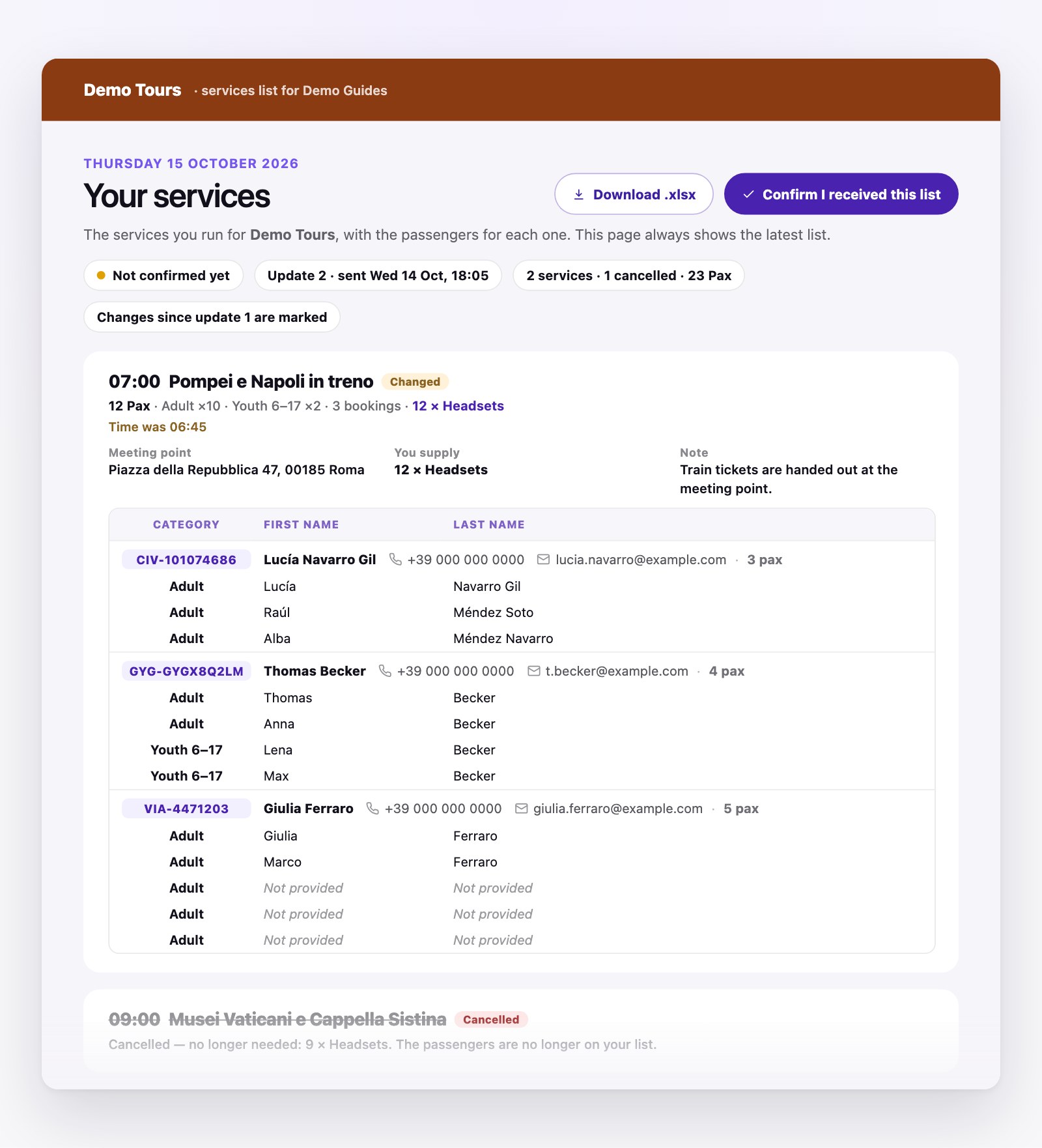
- Partners. A company that supplies you with vehicles, drivers or guides is added once as a partner and assigned like one of your own resources. Every day it receives a single email with the list of its services, the passengers’ names and the phone and email of the customer who booked, with a link to the list page and the Excel file.
- Tickets and files. Vouchers, tickets and instructions are attached to the departure and reach only the staff you choose. Tickets and audio guides can also be counted as stock, so you know how many each day needs.
- Everyone’s day. Every assigned staff member can receive a single email with all their departures for the day, built from a template with the meeting point, times and operational information.
- Costs. With the cost rules you know what each guide, driver or vehicle costs on each departure, and the cost report sums up what your resources cost you over a period.
The full flow, task by task, is in the tour operator software guide.
A job that is done on the ground
An inbound tour operator sells experiences, but the customer judges them on the day: the guide at the right meeting point, the coach at the right time, the ticket with the right name. That is where the next booking is won, and on the OTAs the next review.
To see how TourOperate organises this work, from the booking to the email of the day, read How it works.
Organise your days with TourOperate
Try it free